
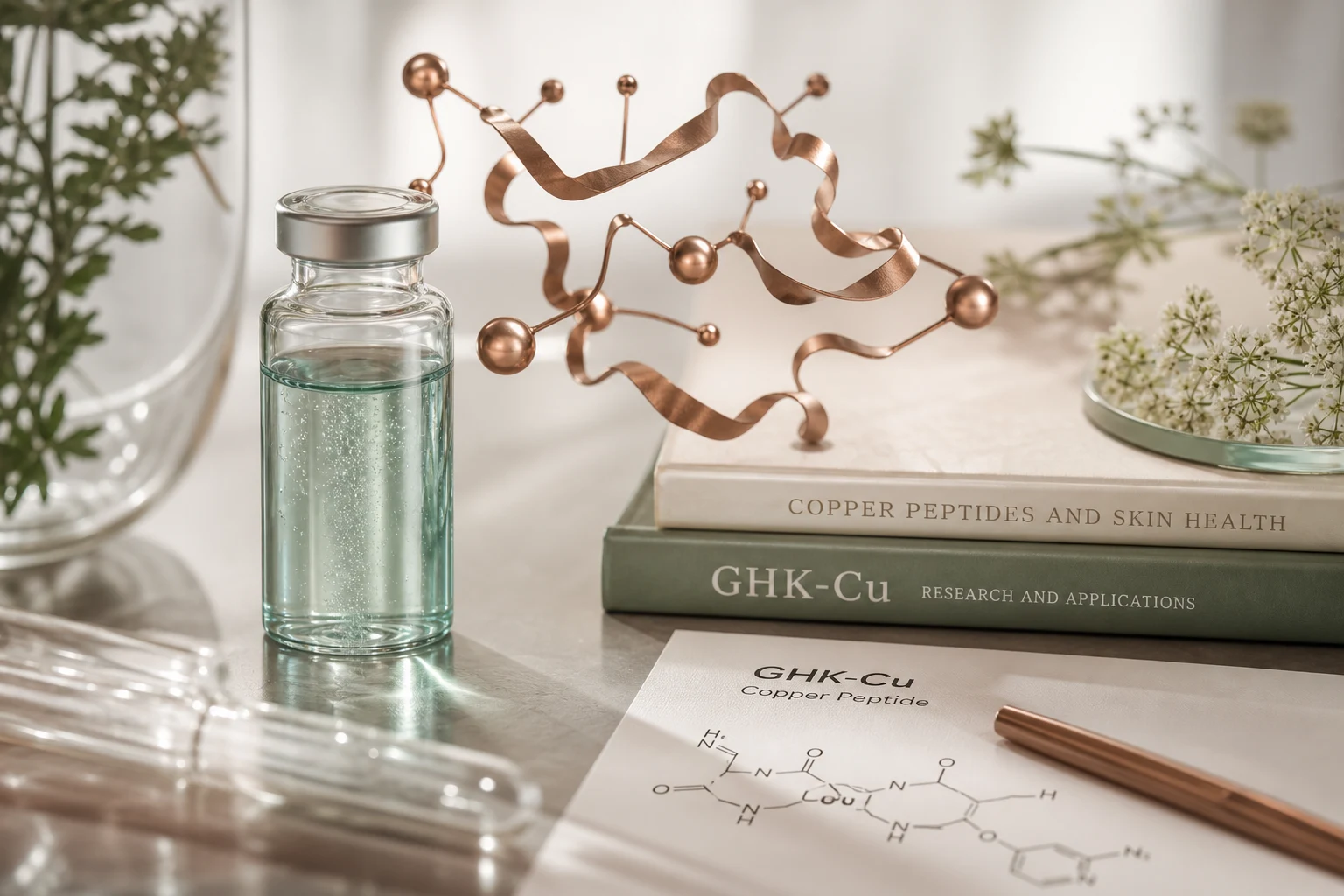
GHK-Cu is one of the rare wellness-market peptides where the hype did not appear out of thin air. The molecule has a long research trail around copper binding, tissue remodeling, collagen and glycosaminoglycan biology, wound repair, inflammation, and skin aging. It also appears on ingredient lists as copper tripeptide-1, usually in topical serums and creams.
The problem is that the internet turns that plausible biology into too many different promises at once: wrinkle reversal, hair regrowth, scar repair, post-laser recovery, nerve repair, cognitive protection, anti-inflammatory medicine, and full-body anti-aging. Those are not the same claim. The evidence is most credible for skin-biology plausibility and limited cosmetic or wound-healing signals, and much weaker for systemic longevity, cognitive, injectable, or hair-restoration claims.
What GHK-Cu actually is
GHK stands for glycyl-L-histidyl-L-lysine, a three-amino-acid peptide found naturally in human plasma, saliva, and urine. The copper-bound version, GHK-Cu, forms when that peptide chelates copper 2+. In cosmetic ingredient language, you will often see it as copper tripeptide-1.
Reviews describe GHK as declining with age in circulation and having high affinity for copper. That makes it biologically interesting because copper is involved in enzymes and pathways relevant to collagen cross-linking, antioxidant defense, angiogenesis, and tissue repair. Interesting does not mean automatically clinically proven; it means the mechanism is plausible enough to study carefully.
Why skincare companies use it
The skin story is the strongest reason GHK-Cu keeps showing up. A major skin-regeneration review reports that GHK can influence collagen, glycosaminoglycans, metalloproteinases, tissue inhibitors, decorin, fibroblast activity, keratinocyte proliferation, immune-cell attraction, and endothelial-cell behavior. In plain English: it is discussed as a signaling peptide involved in remodeling damaged tissue rather than simply moisturizing the surface.
That is why copper peptide serums are usually marketed around firmness, texture, barrier recovery, fine lines, photodamage, and post-procedure support. Those claims are not all equally proven. The most responsible framing is: GHK-Cu has credible mechanistic and preclinical support for skin remodeling, plus some human cosmetic and procedure-adjacent data, but it is not in the same evidence category as prescription tretinoin for photoaging.
The human evidence: promising, but smaller than the marketing
One frequently cited human study tested a post-treatment skincare regimen with or without GHK-Cu after circumoral CO2 laser resurfacing. Thirteen patients completed the study. Computer analysis and blinded evaluators did not find statistically significant differences between groups for earlier erythema resolution, wrinkles, or overall skin quality. Patient-reported overall skin-quality improvement was higher in the GHK-Cu group. That is useful, but small and mixed — not a slam dunk.
Reviews also reference controlled studies in aged skin reporting improvements in elasticity, firmness, fine lines, photodamage, and hyperpigmentation. Those signals help explain why the ingredient is credible enough for skincare, but the public evidence base is still much thinner than the confidence level you see in many peptide-shop descriptions. For consumer readers, the best label is limited clinical evidence, not proven age reversal.
Wound healing: the biology is stronger than DIY use
GHK-Cu has substantial wound-healing interest across animal and laboratory models. In a rabbit open-wound study, topical tripeptide-copper complex was associated with smaller unhealed wound area, greater wound contraction, earlier granulation tissue coverage, and more neovascularization compared with control at several time points. Other models explore hydrogels, diabetic-wound scaffolds, ACL-reconstruction healing, and tissue-injury pathways.
That does not make GHK-Cu a home wound-care protocol. Animal wounds, controlled formulations, sterile study settings, and clinical wounds are different categories. Open skin, burns, infections, post-laser resurfacing, surgical sites, and microneedling all raise product-quality and infection-control questions. A cosmetic serum on intact skin is not the same as putting a peptide into a wound.
The 4,000-gene claim: real discussion, risky interpretation
GHK-Cu content often says the peptide regulates more than 4,000 genes. That claim comes from review discussions of gene-expression analyses, including work using large gene-expression databases. It is not just influencer language; the scientific literature does discuss broad gene-expression modulation.
The catch is interpretation. Gene-expression changes are not the same as a proven clinical outcome. A compound can move thousands of gene-expression signals in a direction researchers call more youthful, anti-inflammatory, or repair-oriented without proving that a person will look younger, heal faster, grow hair, preserve cognition, or live longer. The gene story should be treated as hypothesis-generating biology, not a consumer guarantee.
Inflammation, oxidative stress, and systemic claims
Beyond skin, GHK-Cu has been studied in models of oxidative stress and inflammation. Mouse and cell studies report signals in bleomycin-induced pulmonary fibrosis and lipopolysaccharide-induced acute lung injury, including reductions in inflammatory markers and oxidative-stress pathways. A newer zebrafish-larvae model reports reduced immune-cell migration in induced inflammation models.
These studies are scientifically interesting, but they are not a basis for consumer systemic use. A peptide reducing inflammation in a mouse lung-injury model does not prove that an injectable peptide clinic can safely treat human inflammation, cognition, longevity, or recovery. The further the claim moves away from topical skin and controlled wound biology, the more cautious the language needs to become.
Hair growth: plausible pathway, weak consumer proof
Hair-growth marketing often leans on GHK-Cu because the tissue-remodeling literature mentions hair follicles and because copper peptides are used in some scalp products. The mechanism is not absurd: follicle cycling, vascular signaling, inflammation, and extracellular-matrix remodeling all matter in hair biology.
But mechanism is not enough. We did not find a strong modern, large, peer-reviewed human trial base showing that over-the-counter GHK-Cu reliably regrows hair in common pattern hair loss. If hair is the goal, evidence-backed options such as minoxidil, finasteride or dutasteride where appropriate, diagnosis of shedding triggers, iron/thyroid evaluation when indicated, and dermatologist-guided plans still outrank peptide-serum certainty.
Topical serum, post-procedure product, or injection: these are different risk categories
Most readers will encounter GHK-Cu as a topical cosmetic ingredient. That usually means intact-skin use, lower systemic exposure, and risks closer to irritation, allergy, formulation quality, and unrealistic expectations. It still matters whether the formula is stable, well preserved, fragrance-heavy, irritating, or paired with actives that your barrier cannot tolerate.
Post-procedure use is different. Laser-resurfaced, microneedled, abraded, or wounded skin has a compromised barrier, so sterility, clinician instructions, and timing matter more. Injectable GHK-Cu is a third category entirely. Research-use vials, compounding claims, dose protocols, and DIY injections introduce sterility, dosing, contamination, adverse-event, and monitoring risks that a cosmetic ingredient does not answer.
What to look for in a product
For topical products, the practical questions are boring but useful: Is copper tripeptide-1 clearly listed on the ingredient label? Is the product designed for intact skin or specifically directed by a clinician after a procedure? Does the brand avoid disease-treatment claims? Is the formula compatible with your barrier, retinoids, acids, vitamin C products, and exfoliation routine? Is the packaging airless or otherwise designed to protect the formula?
Be wary of brands that borrow credibility from wound-healing papers while selling broad anti-aging protocols, injectable kits, or guaranteed hair regrowth. Also be careful with strong blue color as a quality proxy; color does not prove concentration, purity, stability, or clinical evidence.
Who should be more cautious
Use extra caution if you have active dermatitis, rosacea flares, open wounds, recent procedures, infection risk, known copper metabolism disorders, pregnancy or breastfeeding questions, a history of keloids or poor wound healing, or a routine already heavy with retinoids, acids, benzoyl peroxide, exfoliation, or devices.
The safest consumer experiment, if a clinician has not told you otherwise, is topical intact-skin use with patch testing and a simple routine. The riskiest interpretation is turning a cosmetic peptide into a self-injection, post-procedure improvisation, or treatment for a medical wound.
The Glow Diary verdict
GHK-Cu deserves more respect than the average peptide trend, but less certainty than the average peptide seller gives it. The molecule has a credible role in skin-repair biology, tissue-remodeling pathways, and preclinical wound-healing models. It also has limited human cosmetic evidence that is interesting but not definitive.
Our practical ranking: plausible topical skincare active, maybe useful as part of clinician-directed post-procedure care, not proven as an anti-aging drug, not a DIY injectable, not a hair-loss cure, and not a systemic longevity protocol. If the claim is about skin texture or barrier recovery, the evidence conversation can be reasonable. If the claim is whole-body age reversal, cognition, organ repair, or guaranteed regrowth, the hype gap gets very large.
Questions to bring to a clinician or dermatologist
Is this being used on intact skin, after a procedure, in an open wound, or as an injection? What exact product and concentration are being used? Is there evidence for the outcome I care about — wrinkles, pigment, scars, hair, healing time, or inflammation — in humans? Could it irritate my barrier or conflict with tretinoin, acids, vitamin C, benzoyl peroxide, or recent procedures? If someone recommends injections, who compounds it, how is sterility verified, what dose is being used, what adverse events are tracked, and why is a cosmetic ingredient being treated like a drug?
Medical note
This review is for education only and is not medical advice. Treatment decisions should be made with a licensed clinician who knows your history, medications, labs, and goals.